
Redesigned concept preview — addressing the 2026-06-06 UX review. View the original site →
Technical reference

The engineering basis behind our products — and our calculators.

An engineer should never have to treat a sizing number as a black box. This page documents the standards we build to, the materials we work in, and the methodology behind the IPAC and SEP tools.

Calculation basis

How the IPAC & SEP calculators size a unit.

The tools apply established, published heat-transfer and fluid-mechanics methods — not proprietary shortcuts. The same methods underpin our manual engineering review of every quote.

Thermal sizing

Heat duty and surface area are evaluated using the log-mean-temperature-difference (LMTD) method with appropriate correction factors, and effectiveness-NTU where flow arrangement requires it. Shell-side coefficients follow the Bell–Delaware framework for shell & tube geometries.
Pressure drop & flow

Tube- and shell-side pressure drop is estimated from standard friction-factor correlations for the relevant Reynolds regime, including entrance, exit and bundle-crossing losses, so a sized unit meets both thermal and hydraulic limits.

Separation sizing (SEP)

Moisture-separator and condensate sizing is based on terminal-velocity / droplet-settling criteria for the design flow and pressure, targeting carryover within accepted industry limits.

Engineering review

Every calculator result is a starting point. Before a quote is issued, a DMI engineer validates fouling allowance, materials compatibility, code requirements and mechanical design against your actual conditions.

Standards & codes

What we design and stamp to.

StandardScopeApplication
ASME Section VIII, Div. 1Pressure vessel design & constructionU-stamped exchangers & vessels
TEMA (R / C / B)Shell & tube mechanical standardsFull TEMA range, removable & fixed bundles
ISO 9001Quality management systemAll manufacturing & inspection
European PED 2014/68/EUPressure equipment directiveUnits destined for the EU market
China & Korea code stampsRegional pressure-equipment approvalExport to those markets

Code applicability depends on service, jurisdiction and customer specification and is confirmed during engineering review.

Materials of construction

Built in the alloy your service demands.

Selection is driven by temperature, pressure, corrosion and the process fluid — confirmed against your conditions before fabrication.

MaterialTypical use
Carbon steelGeneral industrial, compressed-air cooling
Stainless steelCorrosive / sanitary / higher-temp service
AluminumLightweight air-cooled cores & fins
TitaniumAggressive media & seawater service
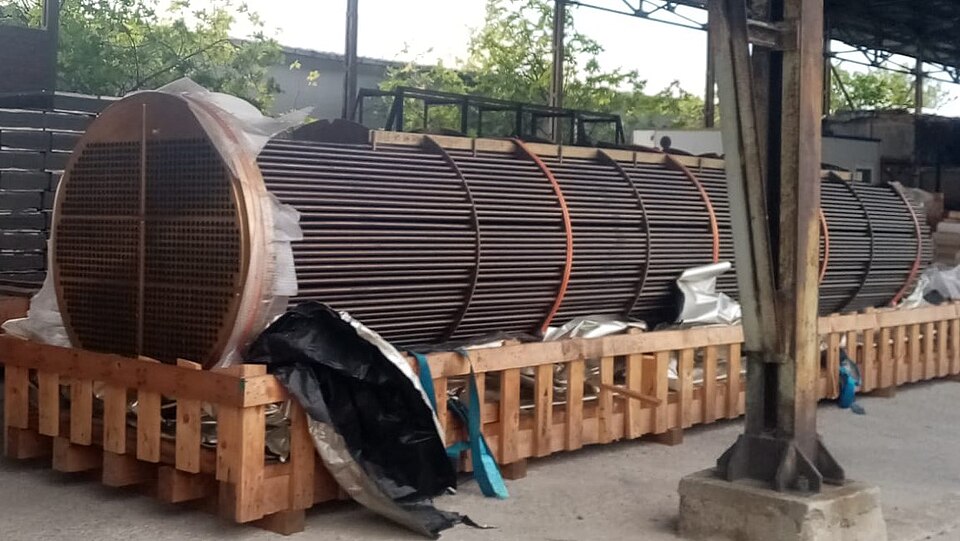
Heat exchanger tube bundle detail
Units & limits of validity

Use the calculators within their envelope.

Accepted units

Flow in SCFM or mass flow; temperatures in °F or °C; pressure in psig or bar; duty in BTU/hr or kW. State your units in the request — our team confirms conversions.

Assumptions

Clean-surface coefficients with a nominal fouling allowance, steady-state operation, and single-phase service unless otherwise specified. Two-phase and condensing duties are handled by engineering review.

When to call us

Pulsating flow, severe fouling, cyclic thermal duty, exotic media or tight space envelopes fall outside the quick-size envelope and should go straight to a quote request.

Size, then send it over. Run the IPAC or SEP calculator, then push the configuration into a pre-filled quote request so we review your exact numbers.

Need a datasheet or a code-compliance letter?

Detailed specifications, reference installations and documentation are available on request as part of a quote.

Request a Quote